
Grant Office, International Policy, and Research Strategy
Through the Grant Office and international strategy, IRST promotes competitive projects, European cooperation, and digital innovation in the service of oncology research. A bridge between science, institutions, and the local area to strengthen the impact of research in Romagna and Europe.
Through the Grant Office and international strategy, IRST promotes competitive projects, European cooperation, and digital innovation in the service of oncology research. A bridge between science, institutions, and the local area to strengthen the impact of research in Romagna and Europe.
The Grant Office, International Policy and Research Strategy Unit is part of the Research, Technology Transfer and Training Office and handles the typical activities of a grant office, while also providing broader support to the Institute's entire research and innovation process, helping to strengthen the ecosystem in which IRST operates through:
- Grant Office – Scouting funding opportunities and supporting researchers through all project phases, from pre-award to post-award;
- Proposal writing – Direct contribution to drafting project sections for international consortia (management, impact, dissemination, communication);
- PI-led project design – Conceiving and coordinating the Institute's own projects based on innovative models (participatory research, open innovation, living labs, ICT, and AI);
- Dissemination – Defining dissemination strategies and scientific communication activities, including international seminars and workshops;
- EU Policy & International Cooperation – Monitoring European policy and building strategic relationships in Brussels to strengthen the Institute's international positioning.
The multidisciplinary team combines scientific, digital, and international policy expertise, enabling the Institute to remain competitive in complex, fast-evolving scenarios.
Within the Unit, experience gained in advanced biomedical research and international PhD programs sits alongside expertise in institutional relations and European policy, as well as digital, ICT, artificial intelligence, and biomedical engineering skills. These are complemented by managerial capacity, participatory research, science communication, and an open-innovation approach. This combination makes it possible to address projects across the full spectrum, from policy to the most advanced clinical and technological research. It is a model that makes IRST competitive at the European level, able to position itself as a comprehensive and authoritative partner.
The Unit's work goes beyond technical-administrative support: it reads calls for proposals from a scientific and strategic perspective, connecting them to IRST's research lines, designing innovative collaboration models, and creating new synergies.
Through its Brussels office, IRST cultivates direct relationships with European networks and institutions, strengthening the Institute's voice on the international stage. With municipalities and local stakeholders, the Unit builds participatory research and territorial innovation projects. With the IRST Data Unit, it works on digital frontiers and artificial intelligence applied to health.
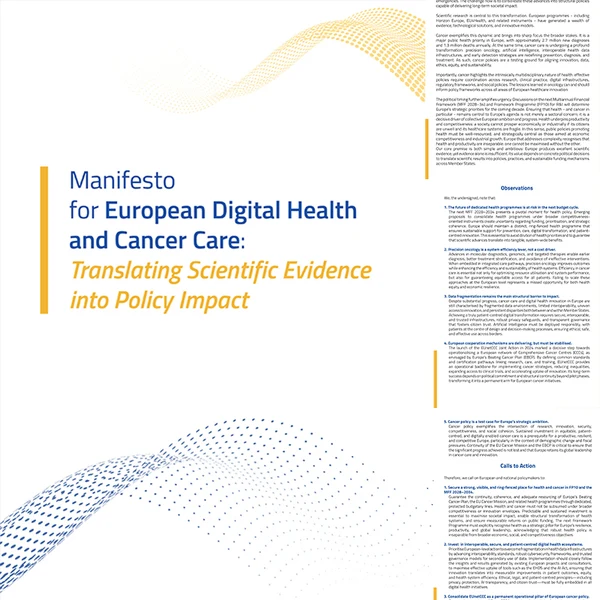
Manifesto for European Digital Health and Cancer Care Translating Scientific Evidence into Policy Impact.pdf
Main activities
Through this Unit, the Istituto Romagnolo per lo Studio dei Tumori (IRST) "Dino Amadori" IRCCS promotes a competitive and sustainable research strategy, capable of making the most of national and European funding opportunities. It supports researchers throughout the entire project life cycle: from analyzing funding programs to building partnerships, from drafting proposals to administrative and financial management. This work connects European and national priorities to the Institute's research lines, turning them into solid, high-impact projects. The quality and scientific consistency of its proposals have made IRST a reliable, recognized partner in the European oncology research landscape.
IRST "Dino Amadori" IRCCS is part of Romagna Next, the largest participatory strategic planning laboratory in the Romagna area. It is a concrete example of the Institute's commitment to collaborating with local institutions and universities to improve quality of life and promote shared innovation. Romagna Next is not an isolated case: the Institute develops participatory research pathways and shared projects with municipalities, local authorities, civic networks, and local ecosystems. Through the organization of events, discussion forums, and opportunities for collaboration, community needs are translated into research and innovation initiatives. The Grant Office, International Policy and Research Strategy Unit is the point of contact for developing initiatives that strengthen these networks and translate European policies into local opportunities. IRST becomes an open-innovation laboratory in the health sector (with a focus on oncology), strengthening the local area's ability to attract investment and projects and to spread a culture of shared research.
Close collaboration with the Data Unit, a key structure for digital innovation and advanced health data management, enables IRST to tackle one of the decisive challenges of contemporary healthcare: digital transition. Specific in-house expertise allows the Institute to fully understand the complexity of these processes and leverage them strategically, connecting clinical research, digital innovation, and European networks. This synergy has positioned the Institute among the first oncology centers to take part in digitally complex European projects such as TRUMPET and FLUTE, focused on the use of artificial intelligence in oncology.
The multidisciplinary nature of the team allows the Institute to take on the leadership of Dissemination, Communication, and Exploitation Work Packages within European projects. Developing integrated impact plans, defining Key Performance Indicators (KPIs) to measure visibility and outreach, and ensuring consistency between scientific dissemination activities and policy-uptake strategies allow IRST to amplify the value of its research results, fostering their adoption in regulatory, clinical, and industrial contexts. This capability makes the Institute an ideal partner for coordinating cross-cutting impact activities in Horizon Europe, Erasmus+, and other European consortia.
The Unit develops and coordinates projects as Principal Investigator, ranging from research and innovation calls to those dedicated to active citizen participation. This is the case, for example, with Erasmus+ projects and European initiatives involving cities and local areas as participatory research laboratories. The Unit is able to develop integrated proposals combining scientific excellence and social impact, acting as a player in both highly technical-scientific projects and citizen science or territorial innovation activities, while always maintaining a strategic vision consistent with the Institute's mission.
The international cooperation activities of the Grant Office, International Policy and Research Strategy Unit are fully integrated with the Institute's presence in Brussels and with its structured collaborations with leading European networks. Find out more in the dedicated sections on the Brussels office and Networks and Collaborations.
The Brussels Office: IRST's Bridge to Europe
Networks and Collaborations
Senior R&I Manager and International Cooperation
paolo.mariotti@irst.emr.it
R&I Manager - ICT & Project Manager
federica.campacci@irst.emr.it
R&I Manager - EU Policy & Project Manager
rosamaria.genovese@irst.emr.it
Last update: 20 August 2026, 15:09