

Research and innovation
Research is the heart of IRST "Dino Amadori" IRCCS: an integrated ecosystem of people, facilities, and projects that brings together care, innovation, and technology transfer to improve patients' lives.
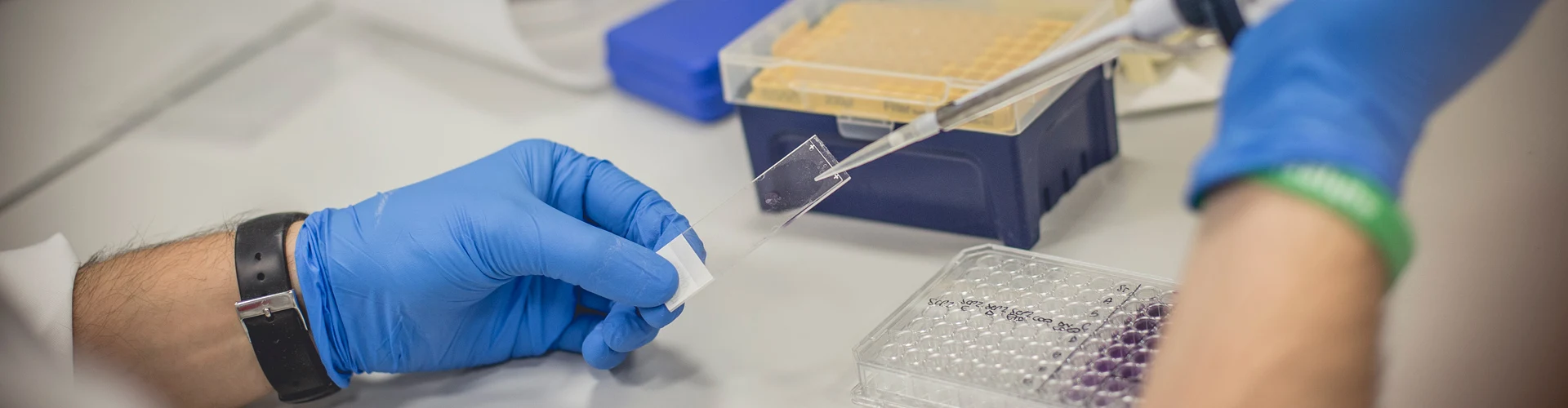
At IRST "Dino Amadori" IRCCS, research is the beating heart of the Institute's mission and the ultimate goal of every project. Progress in the fight against oncological diseases depends, above all, on the constant and increasingly close interaction between care and research activities. This is why we promote solid, innovative, and integrated scientific research covering every stage of knowledge development: from basic research to clinical care practice, through translational research aimed at the rapid transfer of laboratory findings to direct patient benefit. Technological evolution has significantly expanded the possibilities for oncology research, and the time needed for research findings to reach clinical application has also shortened considerably.
To fulfill its mission, IRST actively promotes scientific collaboration with universities, IRCCS institutes, agencies, and some of the leading national and international centers for cancer research and care. IRST's research activities are carried out in ever-closer collaboration with the Romagna Local Health Authority (AUSL della Romagna), within the Comprehensive Cancer Care and Research Network (CCCRN).
Research governance
The Institute's scientific activity is coordinated by the Scientific Directorate, in compliance with Italian Legislative Decree 200/2022 on the reorganization of IRCCS institutes. The Scientific Director, a figure identified for proven experience in the medical-biomedical, economic, and managerial fields, ensures full integration between research, care, and training, following a translational vision: rapidly turning laboratory discoveries into concrete benefits for patients. Together with the Innovation and Research Program IRCCS IRST – AUSL Romagna, the Scientific Directorate is responsible for and coordinates an articulated organizational structure dedicated to supporting and developing the Institute's scientific activities. Within this structure, the Research, Technology Transfer and Training Office provides day-to-day operational support to researchers, from grant management and research contracts to patenting and specialist training.
Research Lines
The Institute's research is organized into four macro research lines encompassing all ongoing projects, in reference to the Italian Ministry of Health.
This research line focuses on the multidimensional evaluation and monitoring of diagnostic-therapeutic outcomes in oncology care pathways, aiming to improve the quality, equity, and sustainability of care. Through the use of algorithms, organizational models, and artificial intelligence tools applied to real-world data, innovative systems for clinical-managerial analysis and governance are developed. The research promotes collaboration within national and international networks to expand case series, reduce regional disparities, and make models more accurate and generalizable.
This research line focuses on the development and testing of innovative oncology therapies, from early-phase clinical trials to therapeutic strategy studies, with particular attention to translating research into clinical practice and to vulnerable populations. Activities include the design and production of Advanced Therapy Medicinal Products (ATMPs), the study of the tumor microenvironment and immuno-oncological mechanisms, as well as the development of new vectors and radiopharmaceuticals for theranostic approaches. Thanks to GMP-certified facilities and consolidated expertise, the Institute promotes independent research and offers cancer patients access to highly innovative therapeutic options.
This research line investigates the biological and molecular mechanisms underlying tumor heterogeneity, studying stem cells, the microenvironment, and genomic and epigenetic trajectories to understand neoplastic progression and treatment response. Through multi-omics approaches, liquid biopsy, immunogenomics, and genome editing, new markers and therapeutic targets are developed for increasingly personalized precision medicine. These activities integrate translational and clinical research, promoting innovative protocols, advanced devices, and collaborations within national and international networks to improve diagnosis, prognosis, and therapeutic strategies.
This research line investigates the genetic and environmental risk factors associated with cancer development, integrating epidemiological, molecular, and lifestyle studies. Particular attention is given to the development and application of innovative, non-invasive technologies — such as liquid biopsy and multi-omics analyses — for the early diagnosis of neoplasms, with a specific focus on those with a familial and hereditary component. The ultimate goal is to promote prevention and cancer interception strategies by identifying the mechanisms of neoplastic transformation at an early stage and opening up new possibilities for therapeutic intervention.
Open Science
Open Science refers to the movement that seeks to make scientific research — its data, methods, and results — open and accessible to all, without restrictions or barriers. Its main goal is to promote collaboration and transparency in scientific research, improving the quality and reliability of results.
In practice, Open Science involves sharing research data, methods, and results through online platforms and public repositories, allowing other researchers to reproduce findings and build on existing work. It also encourages public participation in research, making science more transparent and accessible to all.
The European Commission's eight ambitions
Since 2016, the European Commission has organized its Open Science policy around eight "ambitions":
- Open Data: FAIR (Findable, Accessible, Interoperable, and Reusable) data, and open data sharing, should become the default for EU-funded research outputs.
- European Open Science Cloud (EOSC): a federated ecosystem of research data infrastructures enabling the scientific community to share and process publicly funded research data and results across borders and disciplines.
- Next-generation metrics: new indicators are needed to complement conventional measures of research quality and impact, giving proper credit to open science practices.
- Future of scholarly communication: all peer-reviewed scientific publications should be freely accessible, and early sharing of different types of research output should be encouraged.
- Rewards: research career evaluation systems should fully recognize open science activities.
- Research integrity: all EU publicly funded research should comply with agreed research integrity standards.
- Education and skills: all researchers in Europe should have the skills and support needed to develop open science products and practices.
- Citizen science: the general public should be able to make meaningful contributions and be recognized as a legitimate producer of European scientific knowledge.
IRST's approach
In line with European guidelines and in dialogue with the scientific community, the Institute works to ensure the essential conditions for pursuing Open Science practice are in place, addressing five key challenges:
- Sensitive data protection: effective security mechanisms make it possible to share sensitive data safely, preventing illegal or inappropriate use.
- Data quality: rigorous verification and validation procedures are needed to avoid the risk of disseminating incorrect or incomplete data.
- Intellectual property: Open Science can put researchers' control over their data and discoveries at risk, potentially compromising the intellectual property of research results.
- Costs: proper implementation requires investment in infrastructure, technology, and training for researchers and staff.
- Unequal access: Open Science can widen inequalities in access to data and scientific information, particularly in countries or regions with limited resources or connectivity. Access to Open Science must be fair and inclusive for everyone.
IRST believes its role as a reference center for oncology and onco-hematology research must also be played out within the context of Open Science. The Institute has therefore launched an initiative and opened a space for discussion on Open Science, to support researchers in applying institutional policies and using the tools needed to ensure Open Science is practiced according to its founding principles — reducing the risks of incorrect or unintentional conduct.
Download the IRST Data access agreement terms and conditions (pdf - 149.4 KB)
Last update: 25 August 2026, 13:56