
Care
At IRST "Dino Amadori" IRCCS, cancer care means more than treatment: it means a multidisciplinary team built around each patient, direct access to the most advanced therapies and clinical trials, and a constant, close dialogue between clinical practice and scientific research.
A model built around the patient, not the ward
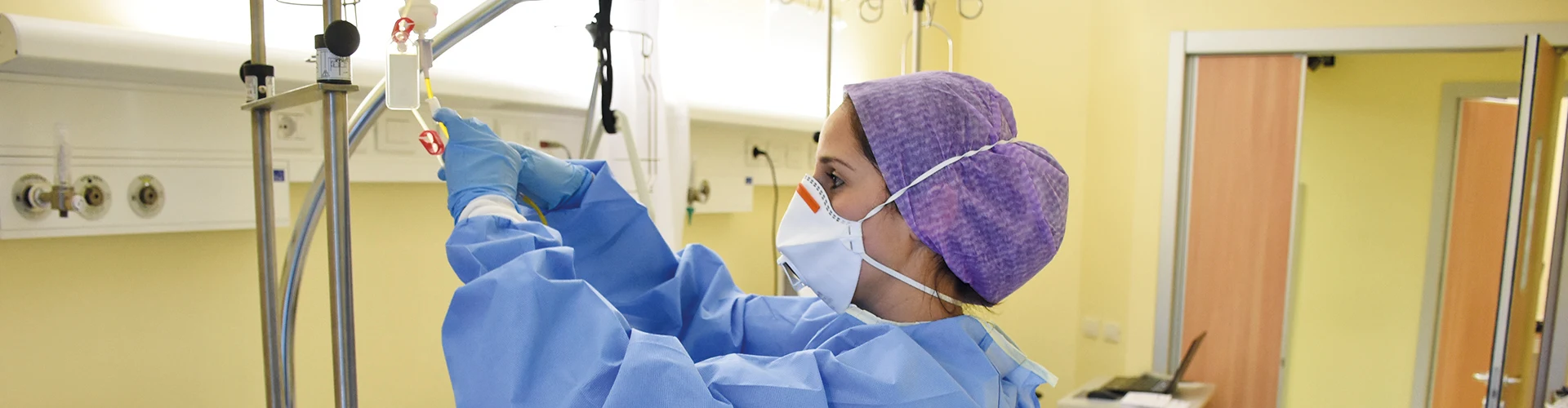
IRST's care model puts the patient at the center — not the physical structure. Rather than organizing care by traditional wards, IRST works through disease-specific multidisciplinary teams: physicians, nurses, data managers, and dedicated pharmacists collaborate around each patient, drawing flexibly on the Institute's full range of services — inpatient care, Day Hospital, outpatient clinics, Radiology, the Bioscience Laboratory, Radiotherapy, and Nuclear Medicine — as the specific pathway requires.
Each patient's diagnostic and treatment journey is discussed and shaped by multidisciplinary case conferences, bringing together IRST and AUSL Romagna specialists to weigh every case against national and international guidelines. To support continuity of care, IRST has also introduced a dedicated case-management nurse for each disease pathway, a role designed to accompany patients and families through increasingly complex treatment journeys.
Inpatient care spans 36 beds (30 in Medical Oncology, 6 in Nuclear Medicine), alongside 28 Day Hospital/Day Service treatment stations across the Meldola, Forlì, and Cesena sites.
Specialized clinical teams
IRST's disease-specific teams cover the full spectrum of oncology and onco-hematology, including genitourinary, breast and gynecological, gastrointestinal, thoracic, skin, and rare cancers, bone and soft-tissue sarcomas, and hematological and stem cell transplantation. Each team integrates its clinical work with translational and clinical research, so patients have access to the most innovative treatment options available. Alongside these, dedicated services support the full care pathway: anesthesia (with a 24-hour service, including holidays), cardio-oncology, clinical nutrition, psycho-oncology, and palliative and pain care.
Advanced technology, concrete outcomes
IRST's technology platform is designed to match its clinical ambition:
- Radiotherapy at Meldola and Ravenna, with two Tomotherapy units and two Linear Accelerators delivering intensity-modulated and volumetric radiotherapy (IMRT–VMAT), plus a dedicated Brachytherapy unit in Ravenna.
- Nuclear Medicine, diagnostic and therapeutic, including PET/CT imaging with radiotracers produced in-house by IRST's own Radiopharmacy, and radiometabolic therapy for neuroendocrine tumors and advanced prostate cancer.
- Radiology, with 256-slice CT, high-field (3 Tesla) MRI, and high-end contrast-enhanced ultrasound.
- Health Physics, ensuring radiation safety and quality control across every service that uses ionizing and non-ionizing radiation.
Where research becomes treatment
Cancer research at IRST is not a separate track: it is built into the care pathway itself. IRST is one of a select number of Italian centers authorized by the Italian Medicines Agency (AIFA) to conduct Phase I clinical trials, offering patients — including those no longer eligible for standard therapies — access to entirely new treatment options, through a dedicated Phase I Clinical Unit.
Every clinical trial conducted at IRST is reviewed for scientific and clinical relevance by the Scientific-Medical Committee, chaired by the Scientific Director, and receives an independent ethical and scientific opinion from the Romagna Ethics Committee (CEROM) — the two-tier safeguard that protects patients' rights, safety, and well-being throughout every study. Participation is always voluntary, based on informed consent, and patients retain the right to withdraw at any time while continuing to receive the best available care.
Care with the person at the center
Alongside clinical excellence, IRST has built a genuine network of support around patients and their families — designed to ease the practical and emotional weight of treatment, not just the medical side of it. This takes shape through volunteer welcome and orientation services present at every site, accommodation support for out-of-town patients and families, a free shuttle service between IRST locations, linguistic and cultural mediation (including sign language interpretation), and structured patient education on oncology medicines to help people take an active, informed role in their own care. IRST is also a fully smoke-free hospital, both indoors and outdoors, and offers free courses for those who want to quit. More recently, the Institute has introduced live-music initiatives to bring moments of relief and normality into its wards and common spaces.
These efforts are guided directly by patients themselves: the "Con-tatto" group, made up of patients and former patients, reviews IRST's informational materials for clarity and contributes to shaping new patient-facing projects, while the Comitato Consultivo Misto (CCM) — bringing together patient associations, general practitioners, and IRST representatives — helps monitor and improve service quality from the citizen's point of view.
Rights, safety, and quality
IRST's commitment to patients is formalized as a set of explicit, measurable standards — not general statements of intent. Independent patient satisfaction surveys ("Insieme per migliorare") track, among other things, satisfaction with hospitality and comfort (target: ≥80%), staff courtesy and information quality (target: ≥70%), and respect for privacy (target: ≥70%). A dedicated Patient Safety Plan governs incident reporting, infection prevention, correct patient identification, and pharmacovigilance, with results published annually. All informational materials are reviewed against Health Literacy principles and validated with the "Con-tatto" patient group before publication.
IRST's commitment to patients is formalized as a set of explicit, measurable standards — not general statements of intent. Independent patient satisfaction surveys ("Insieme per migliorare") track, among other things, satisfaction with hospitality and comfort (target: ≥80%), staff courtesy and information quality (target: ≥70%), and respect for privacy (target: ≥70%). A dedicated Patient Safety Plan governs incident reporting, infection prevention, correct patient identification, and pharmacovigilance, with results published annually. All informational materials are reviewed against Health Literacy principles and validated with the "Con-tatto" patient group before publication.
Last update: 01 October 2026, 09:46